

Cairo's OOH Market in July 2026: Real Estate Loosens Its Grip, But Doesn't Let Go
Spend a morning moving through Cairo this July, from the Ring Road down through New Cairo and out toward Sheikh Zayed, and the city's billboards read like a ledger of who currently has something to say. A developer's launch date here, a bank's new rate there, a car brand's badge catching the light at an interchange it did not occupy a year ago. Real estate still writes most of the ledger, the way it has for years, but this July the entries around it are harder to skip past than usual. July 2026 confirms the pattern that has defined Cairo's OOH market for some time, real estate first and everyone else after, but it also complicates it, because for the first time in a while, real estate's grip on the city's billboards has loosened just enough to notice.
Noteworthy Changes
The month closed with 430 active OOH campaigns across Cairo, split almost evenly into 172 new launches and 258 running holdovers, a 40 to 60 ratio that suggests a market still refreshing itself at a healthy clip rather than coasting on legacy bookings. Alongside them, 174 new locations entered the inventory, a sign that supply is still expanding to meet demand rather than the reverse. Total available faces reached 20,411, of which 17,897 were occupied, putting occupancy at 88 percent against 12 percent availability. That is a modest but real improvement on July 2025's 86.5 percent occupancy, and in a market this size, two points is the difference between a landlord who negotiates and one who does not need to.
Sectoral Distribution
Real estate still leads by a wide margin, claiming 58 percent of occupied ad faces this July. But set against last year's 61.9 percent, the drop is worth sitting with. Real estate has not lost its dominance so much as loaned a few points of it out, and the sectors that picked them up tell their own story. Automotive more than doubled its share, climbing from 2.4 to 6 percent, driven in part by Chinese entrants like Geely and Linglong Tire pushing into a category long treated as an afterthought on Cairo's boards. Consumer electronics followed a similar arc, doubling from 1.4 to 3 percent. Healthcare grew from 2.5 to 4 percent. Telecommunications held its ground at 7 percent and FMCG stayed close behind, also at 7 percent, both essentially flat year over year. Finance and investment eased back from 4 to 3 percent, and hospitality contracted more sharply, from 2.6 to 1 percent, ceding space to categories with more urgent news to announce. None of this unseats real estate as the market's anchor tenant. It does suggest the tenants around it are getting louder.
Top 5 Campaigns
Where 2025's leading campaign topped out at 145 ad faces, this July's top spot ran on 697, a scale jump that says as much about the market's appetite as any single developer's ambition. Pause North Coast took the top position with "Between Nostalgia & Noise," followed by Perla's "Natives of the Sea" at 331 faces and Make Place Development's "Places You Already Know" at 314. Youd Ras El Hekma rounded out the top five with "Ready to Move Units, 8 Years Installments" at 254 faces, and Sa'ada North Coast closed it with "Sa'ada Beach Is Now Open" at 236.
What ties them together is geography as much as scale. Where 2025's top five spread across New Cairo, West Cairo, and the coast in roughly equal measure, this July's leaders cluster almost entirely around the North Coast and Ras El Hekma, a concentration that repeats further down the list too, in Nammos Resort Ras El Hekma, Lyv Ras El Hekma, and Il Cazar's Safia & C North boutique beachfront project. The coast has stopped being one storyline among several and become the market's dominant address.
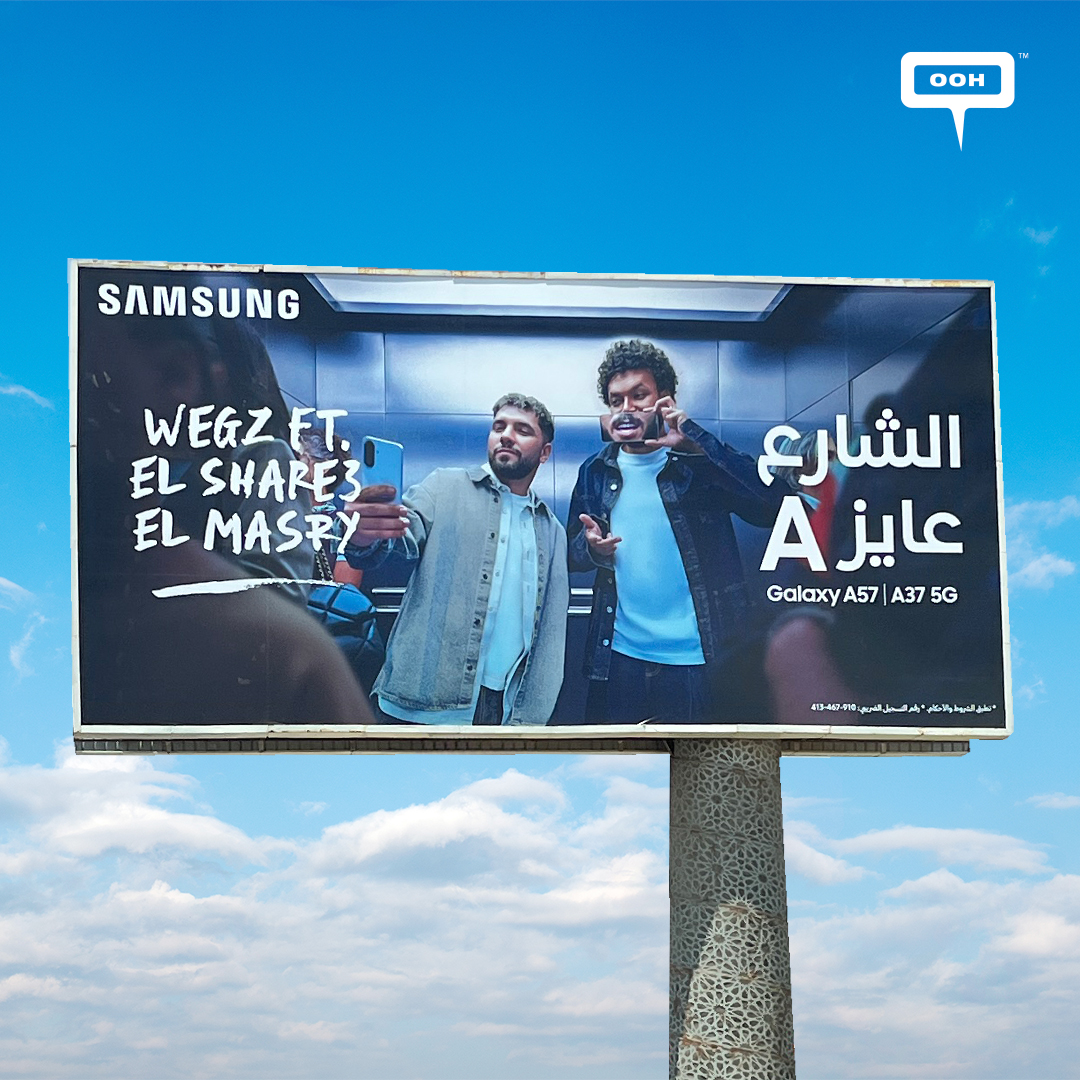
Real estate was not the only sector to break into the upper tier. Samsung landed at seventh with 216 faces for its Galaxy S26 Ultra and Galaxy AI campaign, the sole technology brand to crack the top ten, a continuation of the multi-year cultural investment the brand has built in the city's DOOH landscape.
The Wider Picture
July 2026 is not a market in transition so much as one recalibrating its center of gravity. Real estate remains the backbone of Cairo's OOH economy, but the composition beneath it is shifting toward automotive and consumer tech, categories that spent years on the margins of the city's billboards and are now buying their way toward the center. Occupancy is tightening, new locations keep entering supply, and the coast has, for now, become the address every major developer wants their name attached to. Whether that concentration holds through the next reporting cycle, or whether the capital reclaims some of the ground it lost this July, is the question worth watching next.
For a more in-depth analysis of July 2026's market insights, including detailed data and statistics on Cairo's billboard landscape, please explore our further research at MOOH.
Come on, tell us what you feel about this article.
Learn about this campaign budget, media plan, campaign data